Journal
How many of each size? A shirt bar sizing breakdown
The size curve that actually works at a custom shirt bar, how much to over-order, and how to avoid the classic failure where the last guests in line get nothing that fits.
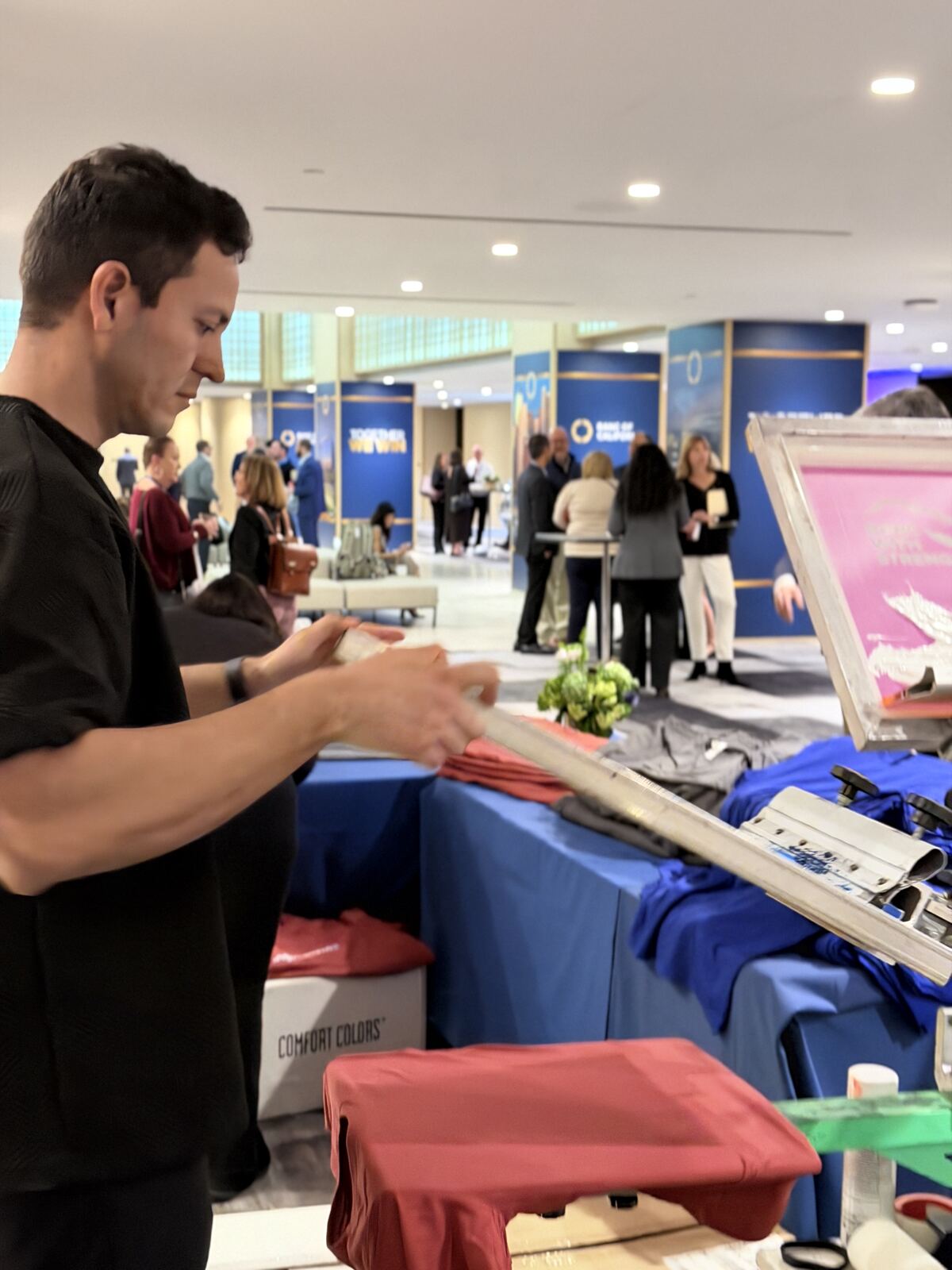
There is exactly one way a shirt bar fails in a memorable way, and it isn't a printer jam. It's the moment at hour two when someone walks up, asks for a large, and there aren't any. Everything else — a slow line, a smudged print, a design nobody picked — is recoverable. Running out of the middle sizes is not.
So this is the unglamorous post: how many of each size to bring. It's the question we get asked least and the one that decides whether your event goes smoothly.
The default size curve
For a general adult crowd in the United States, the distribution that holds up across most events looks like this:
- Small — 8%
- Medium — 20%
- Large — 28%
- XL — 24%
- 2XL — 13%
- 3XL — 7%
Large and XL together are more than half your stock. That is the single most useful thing to know, and it's where under-ordering hurts, because those are also the sizes that go first.
Two caveats. This curve assumes unisex cuts, which is what most shirt bars run. And it assumes an adult crowd with no particular skew — which is a real assumption, not a safe default, as the next section covers.
When to break from the default
The curve shifts, sometimes a lot, depending on who's actually in the room.
Fashion-leaning and lifestyle events pull noticeably smaller. People size down for fit rather than up for comfort. Shift roughly one step toward small and medium, and don't be surprised if you burn through smalls first.
Trade shows and conferences run larger than the default, and they run oversized on purpose — attendees take the shirt home for someone else, or want it loose over a polo. Weight toward XL and 2XL.
Family and community events need a youth run, which the standard curve ignores entirely. Youth S through XL at about 15 to 20% of total stock, on top of the adult curve, not carved out of it.
Corporate all-hands are the easiest case, because you can ask. If HR already has sizes on file from a previous shirt order, use those numbers instead of any curve. Real data beats a distribution every time.
Athletic and sports activations skew large and tall. Consider adding LT and XLT if you're printing for a team crowd.
How much to over-order
Order for 110 to 120% of expected attendance, not 100%. This feels wasteful on the invoice and it isn't. Here's why.
Not everyone takes a shirt — realistically 60 to 80% of attendees will, depending on how visible the station is. That would argue for ordering less. But take rate isn't the constraint; size availability is. If you order exactly 200 shirts for 200 people using a perfect curve, you'll still run out of large by the time 140 people have come through, because the curve describes the crowd, not the order in which they show up. The buffer isn't for extra people. It's for the tail of the distribution.
Leftovers aren't a loss, either. Blank garments stay useful — they go back to the office for new hires, or into the next event. We've had clients run the same buffer stock across three events in a year.
Running the size table so it doesn't become the bottleneck
A few operational things that matter more than they should:
- Fold and stack by size, in one place. Not spread across the table. Guests self-serve their size and hand it to the press operator, which cuts a whole interaction out of the line.
- Put out a sizing chart with actual measurements. Chest width in inches, laid flat. It stops the "do you have this in a real medium" conversation.
- Hang one of each size as a sample. People size correctly the first time when they can see the garment on a hanger.
- Watch the middle sizes and say something early. Our crew flags it when large drops low, so you can decide whether to hold back stock for a VIP group or a later session rather than discovering the problem when it's already a problem.
We've run shirt bars for crowds from 50 to several thousand, including activations for Riot Games and Coca-Cola, and the sizing conversation happens before every single one. It takes ten minutes and it's the highest-leverage part of planning.
Frequently asked questions
What if we genuinely don't know how many people are coming?
Give us your best low and high estimate and we will build stock to the high number with a size curve that covers both. Blanks that go unused are returned to you rather than billed as a loss, so a wide estimate costs far less than running short.
Should we offer both unisex and women's cut shirts?
It depends on the crowd. Most shirt bars run unisex only and it works fine, because oversized is a normal way to wear a tee. For events with a strongly female-skewed audience, adding a fitted cut is worth it — but it doubles the sizing decisions, so plan on a slightly slower line.
Can we add sizes on the day of the event?
Not reliably. Blanks are sourced and staged ahead of the event, and same-day restocking depends entirely on what a local supplier happens to have. This is exactly why we over-order — the buffer is far cheaper than an emergency run.
Book the bar
Lock in your date.
Send the basics and we will come back with a shirt bar plan sized to your crowd.
- One flat price — blanks, printing, crew, and setup rolled together.
- We bring the tables, presses, garment wall, and design menu.
- Deposit holds the date; the rest is due after the event.